
There is a point in the life of most franchise networks when growth starts to feel like proof. The brand is known, enquiries arrive without much effort, new outlets open on a steady schedule and head office is busy. From the outside, and often from the inside too, it looks like success.
Sometimes it is. But after nearly 30 years of working inside franchise networks, I have learnt that a growing network and a healthy network are not the same thing. Opening outlets tells you that people want to buy into your brand. It tells you far less about whether the outlets you already have are working as they should. That is what franchise network health is really about, and it is a question I believe every established franchisor should ask before signing the next franchise agreement.
More outlets do not automatically mean a stronger network
Outlet count is the number most franchisors report first and the number most people outside the business notice. It is also the easiest number to misread.
A new outlet brings an initial fee and, over time, royalties. What it does not automatically bring is strength. If the site was a compromise, if the franchisee was approved because the pipeline needed filling, or if the support behind that outlet is already stretched, the network has grown in size but not in capability.
When I look at franchise network performance, I am less interested in how many outlets have opened than in how they are trading two or three years later, and whether the people who own them would make the same decision again.
When your best outlets hide the rest
Most established networks have a group of outlets that perform consistently well, often the early ones. They matter enormously, but they can also distort the picture.
Network averages are particularly misleading. A handful of strong performers can lift average turnover to a comfortable level while a meaningful number of outlets are struggling, breaking even or quietly losing money. If leadership only sees the average, or the top of the league table, the problems underneath stay hidden until they surface as disputes, closures or franchisees who simply stop investing in their businesses.
If you took your strongest outlets out of the numbers, what would the rest of the network look like? How many outlets are trading below the level you promised, or implied, when you sold the franchise? And do you know why?
Franchisee profitability is not a secondary issue
A franchisor can be doing well while its franchisees are not. Fees are usually calculated on turnover, so head office income can hold up even when franchisee margins are under pressure from rent, wages, stock costs or a fee structure that no longer fits the economics of the outlet. I have written about getting that balance right in franchise fees and return on investment, and about why franchisor health and franchise network health are not the same thing.
Over time, though, the two cannot be separated. Franchisees who are not earning a sustainable return stop reinvesting, become harder to support and are far less likely to recommend your brand to the next prospective franchisee. Franchisee profitability is the foundation on which sustainable franchise expansion is built. If it is weak, every new outlet adds to the strain rather than relieving it.
Do you have reliable information on what your franchisees actually earn? Not what they turn over, but what they take home once every cost has been paid?
Has head office kept pace with the network?
Networks often grow faster than the structures that support them. The head office that comfortably looked after the network a few years ago is now expected to support one that is considerably larger, frequently with much the same people, the same systems and the same field visits spread more thinly.
The signs tend to be familiar. Field support becomes reactive rather than developmental. Standards are applied differently from one region to the next. Reporting depends on spreadsheets that someone compiles by hand, so by the time a problem is visible it has already cost money. This is one of the reasons I believe franchisors need a proper franchise management system rather than a collection of processes.
Is your support structure designed for the network you have today, or for the one you had a few years ago? Could you grow significantly without your existing franchisees noticing a drop in the support they receive?
The cost of expanding before you are ready
Growth amplifies whatever is already in the network. Sound systems, careful site selection and well-supported franchisees become more valuable as the network grows. Weaknesses multiply in exactly the same way.
Expanding before addressing operational problems means new franchisees inherit those problems from their first day of trading. Head office attention shifts to recruitment and openings at the very time existing outlets need it most. Prospective franchisees talk to existing ones before they invest, so the condition of your current network is either your most persuasive sales tool or your biggest obstacle.
Healthy networks benefit from a regular check-up too
None of this means that growing networks are in trouble. Many are well run and genuinely ready for their next stage. But even successful franchisors benefit from stepping back periodically and looking at the network as a whole, rather than through the lens of this month’s openings or last month’s turnover.
A structured franchise network assessment confirms what is working, so that it can be protected as the network grows. It identifies the areas that need attention while they are still manageable. And it gives the leadership team a shared, evidence-based view of where the network stands, which makes growth decisions far easier to agree on.
Turning findings into a plan
An assessment is only as useful as what changes because of it. A thoughtful report that is read once and filed changes very little. The value lies in converting what you learn into specific actions, with clear responsibilities, realistic timeframes and measures that show whether things are actually improving.
That is what turns a franchise growth strategy from an ambition into a plan. It also gives you a baseline to return to, so that a year from now you can see what has really changed rather than relying on impressions.
A practical place to start
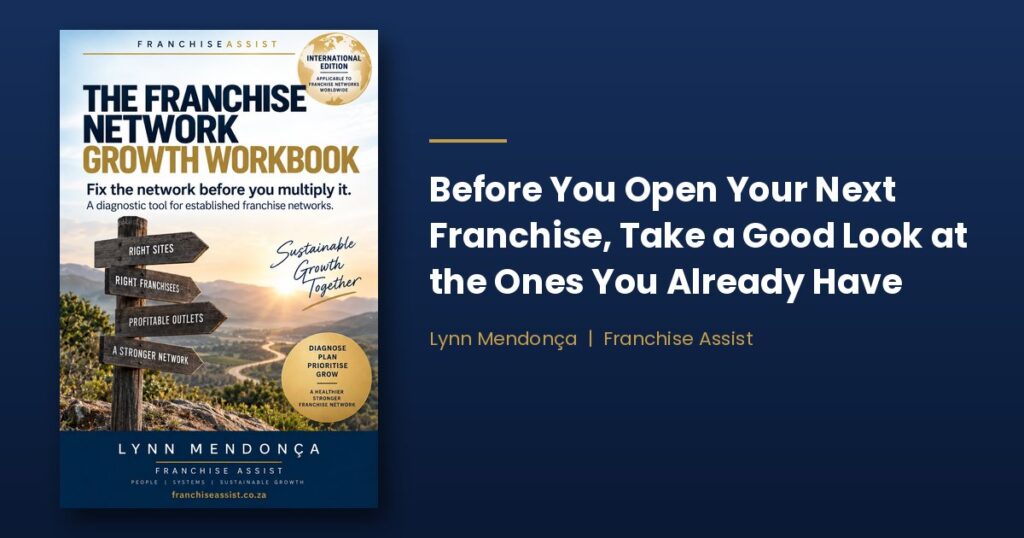
To help established franchisors do this, I developed the Franchise Network Growth Workbook, subtitled “Fix the Network Before You Multiply It”. It is a structured strategic assessment that the franchisor’s own leadership team completes within the business, using its own numbers. It looks at how the outlets are really performing, whether franchisees are making a sustainable return, how decisions about sites and franchisees are being made, whether head office capacity has kept pace with the network and what rate of growth the network can realistically carry.
Leadership teams come away with a clear view of where their network stands and a practical 12-month network plan built from their own findings, with a baseline to revisit each year.
If you would like to learn more about the workbook, or to talk through your network’s growth readiness, I would be glad to hear from you. You can contact Franchise Assist here, or read more about our franchise network support for established franchisors in South Africa and internationally.